
Implant Retained Dentures in Cheshire with Dr Nikhil Oberai
If you are wearing dentures that move, restrict what you eat, or make you self-conscious in social situations, there is a more stable, more comfortable solution that does not require you to commit to fully fixed teeth.
A denture was supposed to solve the problem. For most people, it has not.
The patients I see about implant-retained dentures have almost always been wearing a conventional denture for some time. They accepted it because they were told it was the best available option, or the only realistic one. And they have been managing the limitations ever since.
The limitations are significant. They just tend to creep in gradually, in the way that adaptations do, until managing around the denture has become so normal it feels like it is simply part of life. It does not have to be.
- Why patients come to see me
Do any of the points below sound familiar?
Your denture moves when you eat or speak
The slipping, the shifting, the moment in a conversation where you become aware that something has shifted. The adhesive that was supposed to solve this does not quite solve it. The constant low-level monitoring of where the denture is and whether it is about to embarrass you. This is what patients describe most often, and it is exhausting in a quiet, cumulative way.
You have stopped eating certain foods because of it
Anything that requires a proper bite or sustained chewing has quietly come off the menu. Not dramatically. Just gradually. Sticky foods, hard foods, anything that tests the stability of the denture. You have adapted around it so thoroughly that you may not fully notice how restricted your diet has become.
You feel self-conscious in social situations
Meals with other people. Meetings. Conversations that involve laughing or talking animatedly. There is always a part of your attention on the denture. Whether it is going to slip. Whether it is visible as a denture to the people around you. That self-consciousness takes something away from situations that should simply be enjoyable.
You remove it every night and the routine has become something you resent
The cleaning, the soaking, the separate container on the bedside table. The fact of it. The constant reminder that this is a prosthetic rather than a real part of your mouth. Patients do not always articulate this one clearly, but it is there in almost every conversation I have about conventional dentures.
What implant-retained dentures actually are, in plain English
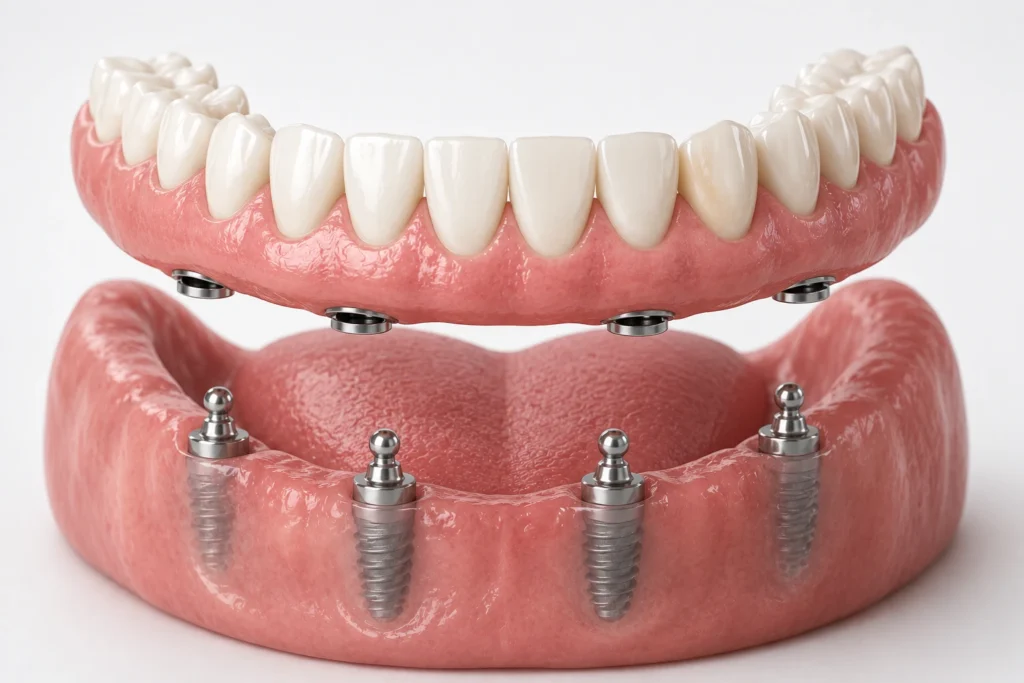
A conventional denture rests on the gum surface and is held in place by suction and, in many cases, dental adhesive. There is no connection to the underlying bone. As the jawbone gradually recedes beneath the denture over time, the fit gets looser, the suction reduces, and the movement increases.
An implant-retained denture works differently. Two to four small titanium implants are placed into the jawbone. The underside of the denture has corresponding attachment fittings that click firmly onto these implants when the denture is inserted. The result is a denture that is mechanically secured to the jaw rather than simply resting on it.
The implants also stimulate the jawbone the way natural roots do, which slows or prevents the bone resorption that makes conventional dentures progressively looser over time. The long-term fit of an implant-retained denture is significantly more stable than a conventional one as a result.
Cleaning is straightforward. The denture is removed, cleaned separately, and clicked back into place. The implants themselves are cleaned with a standard toothbrush. The routine is no more complex than cleaning a conventional denture, but the result is incomparably more stable.
- Real Patient Results
Thousands of Smiles Transformed
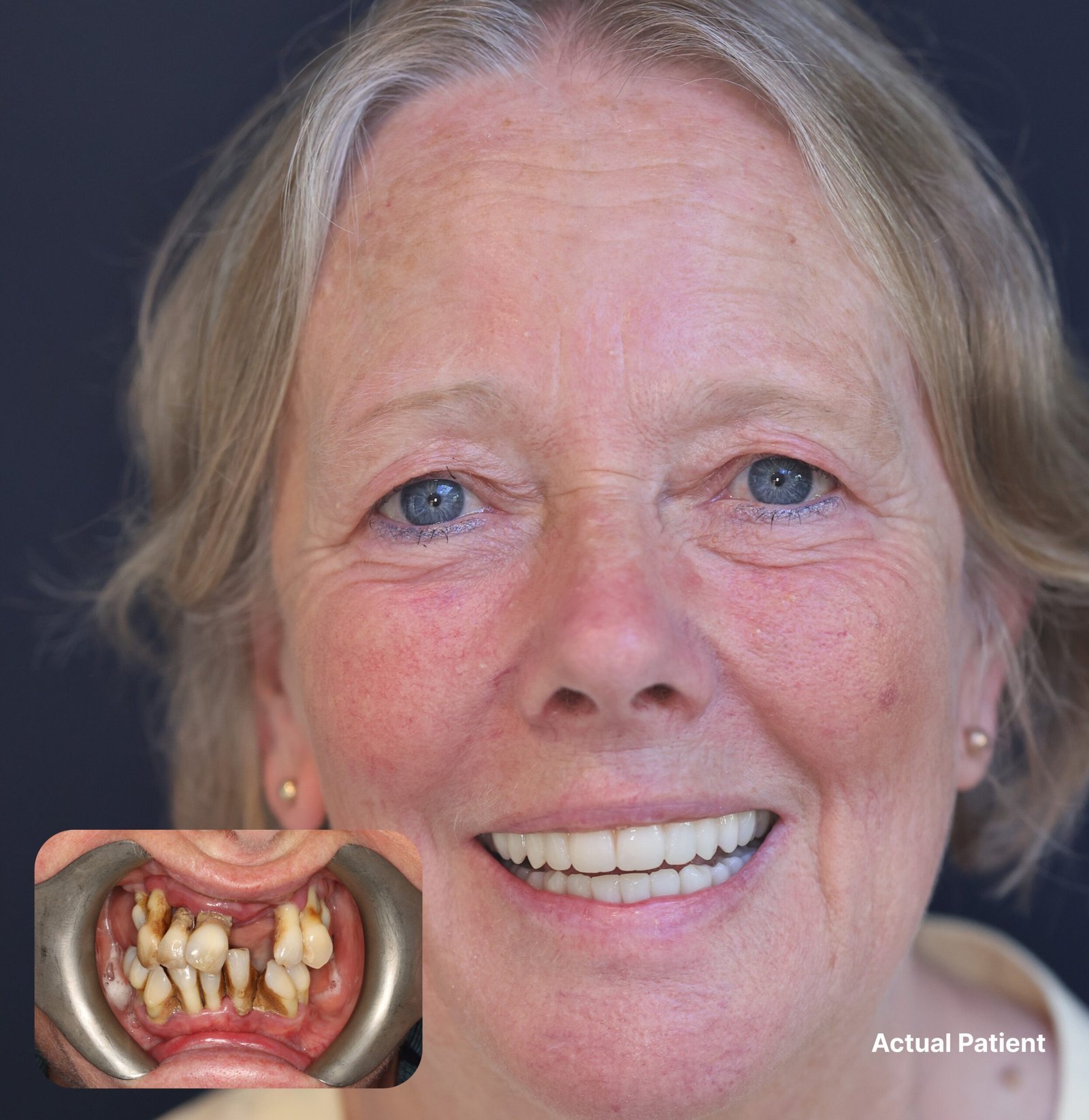
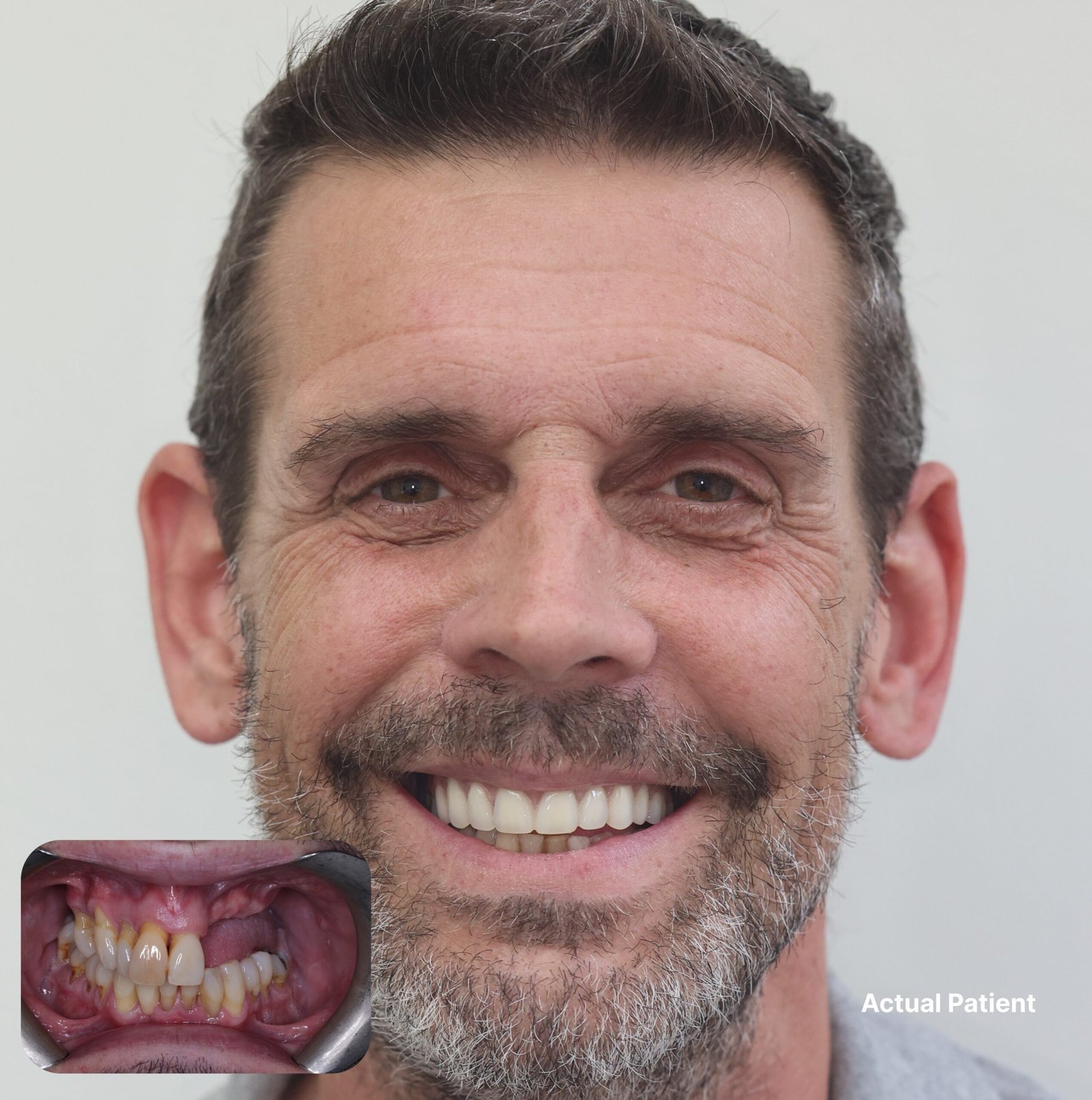
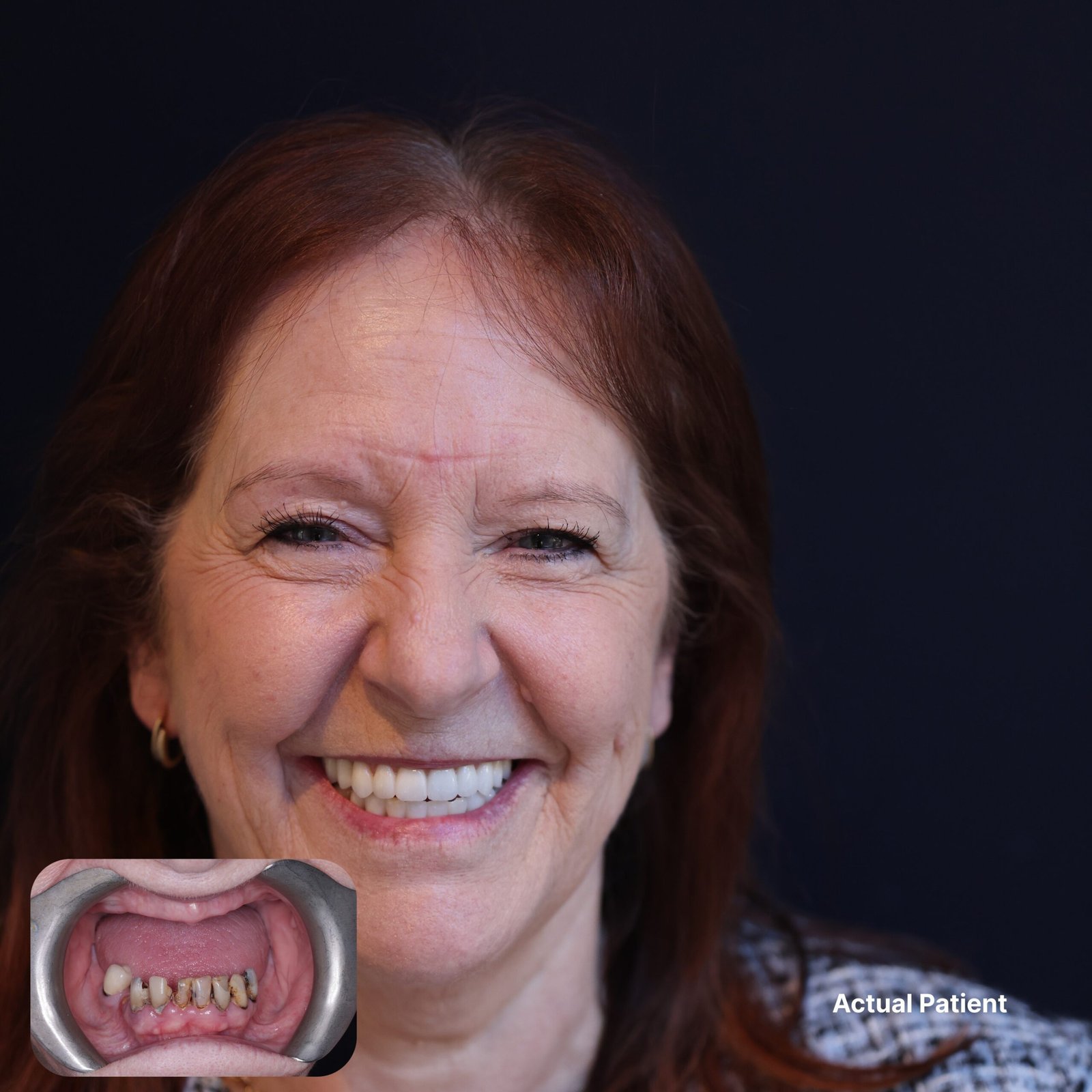
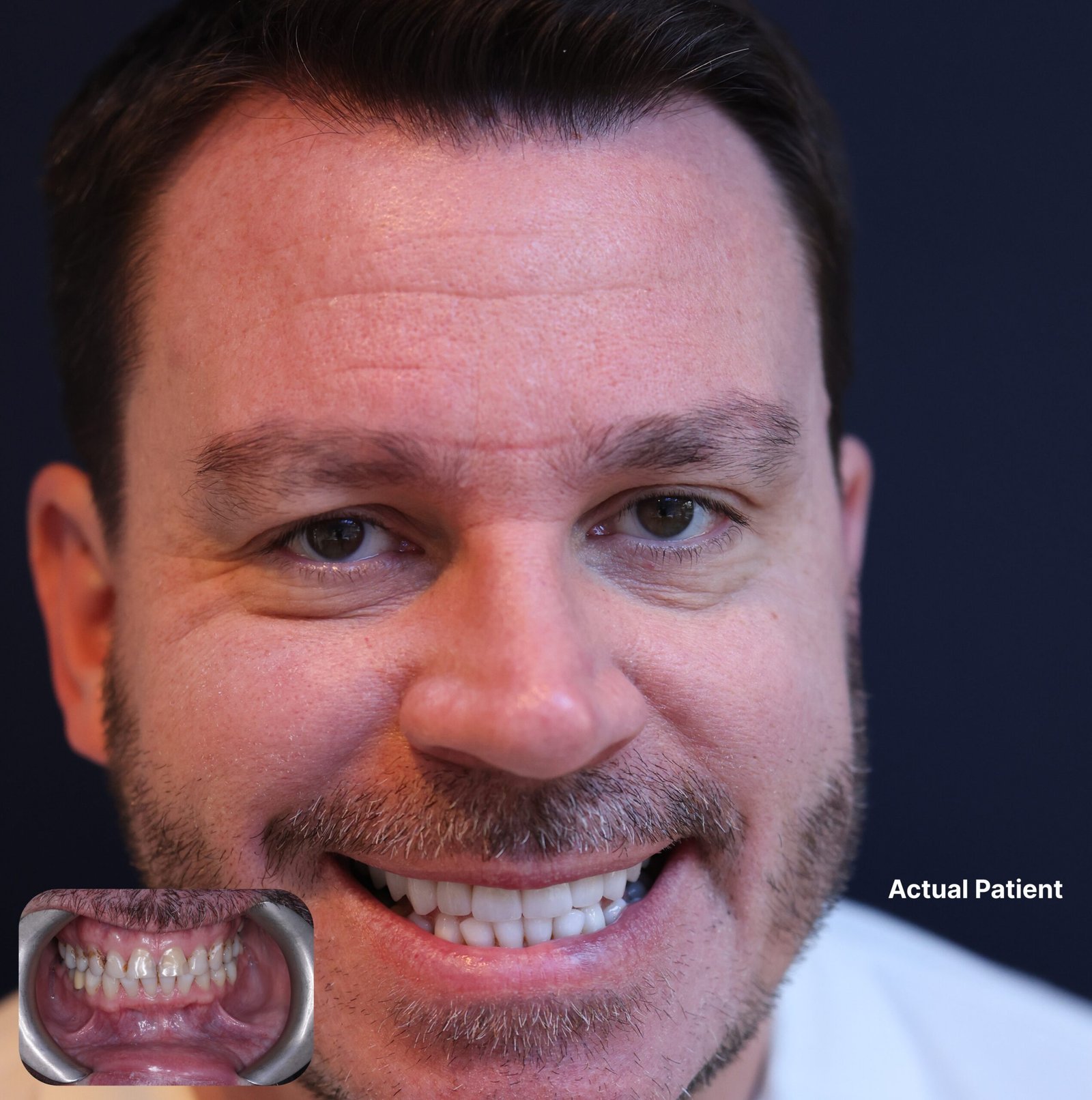
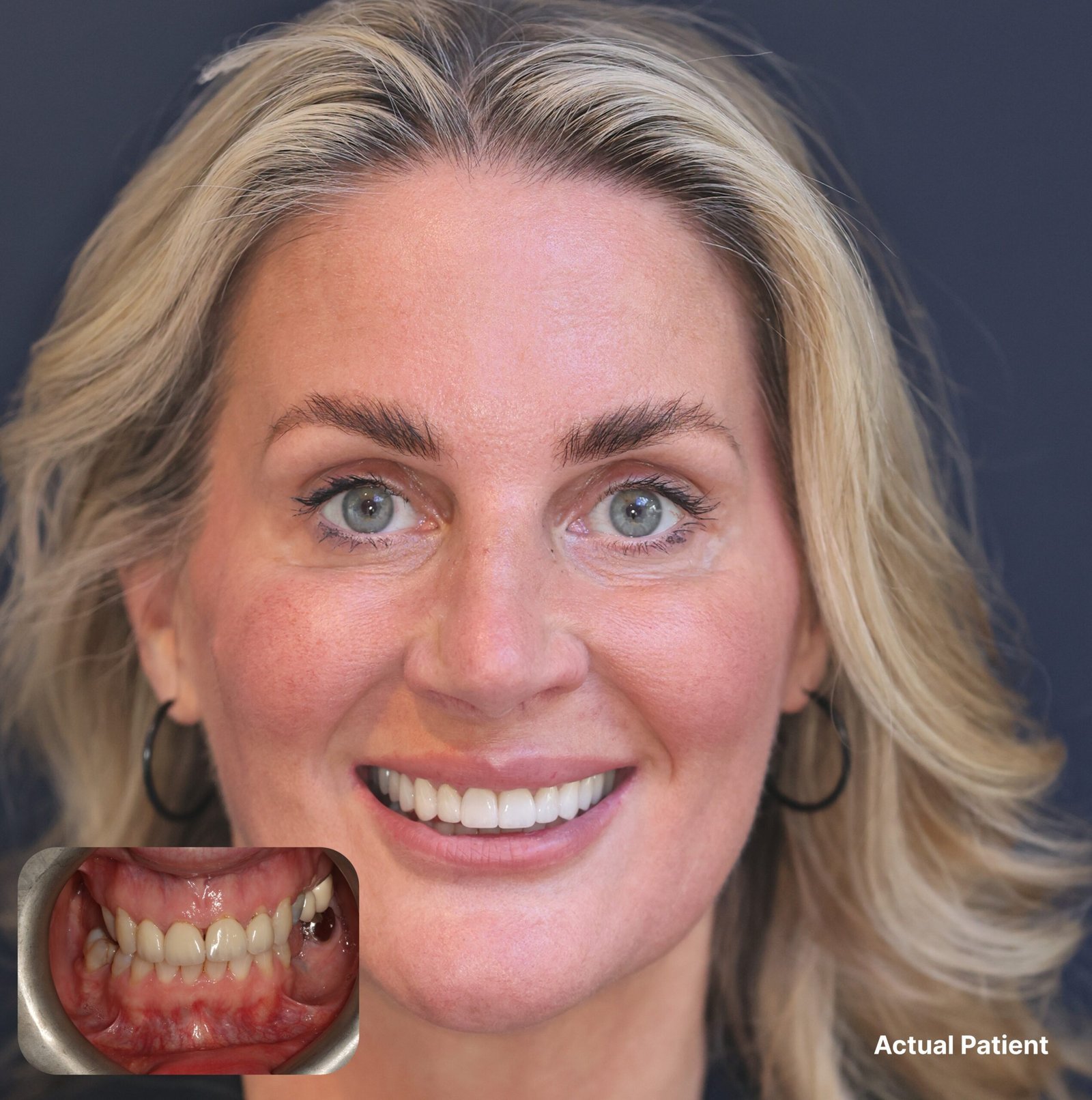
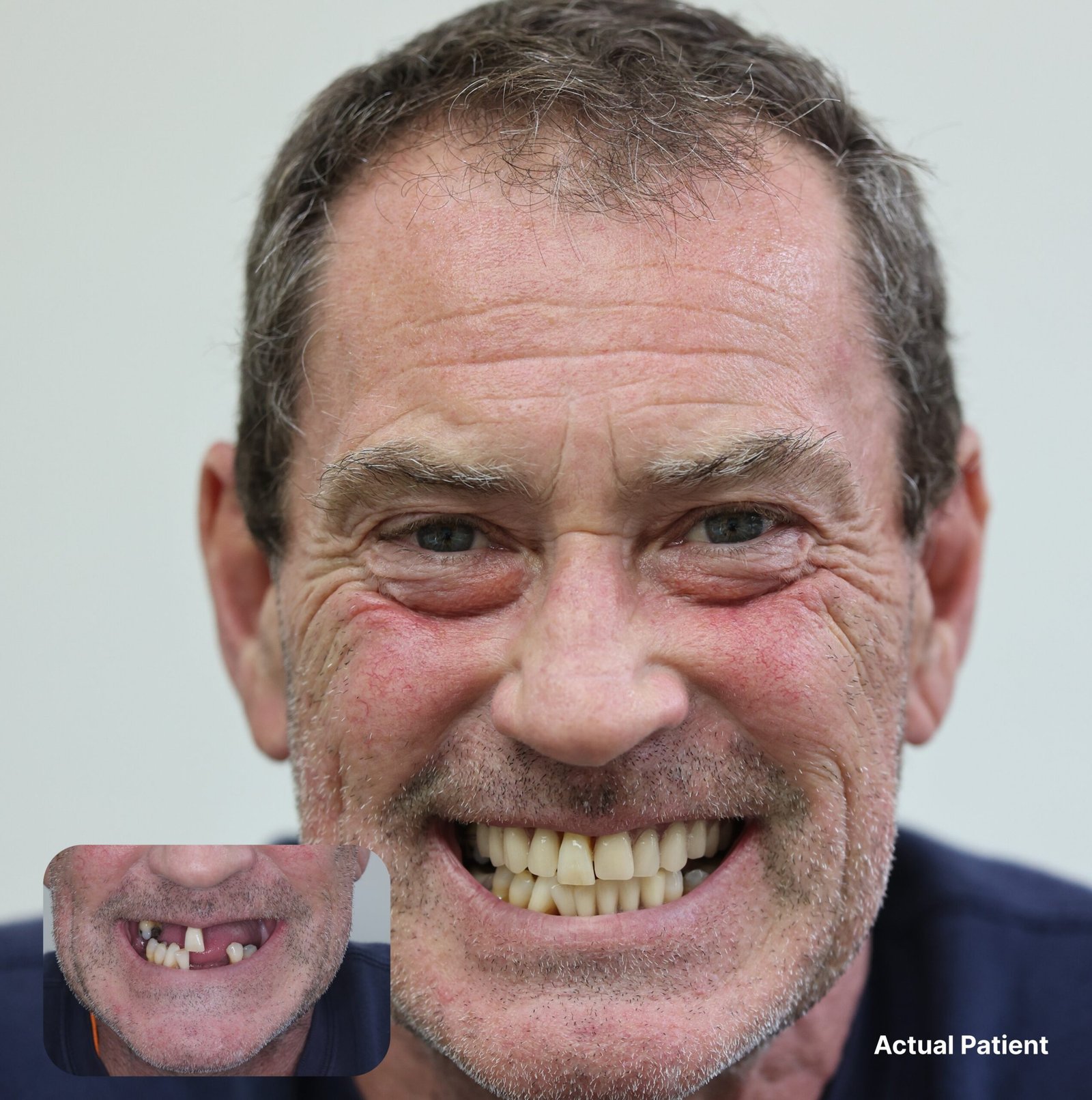
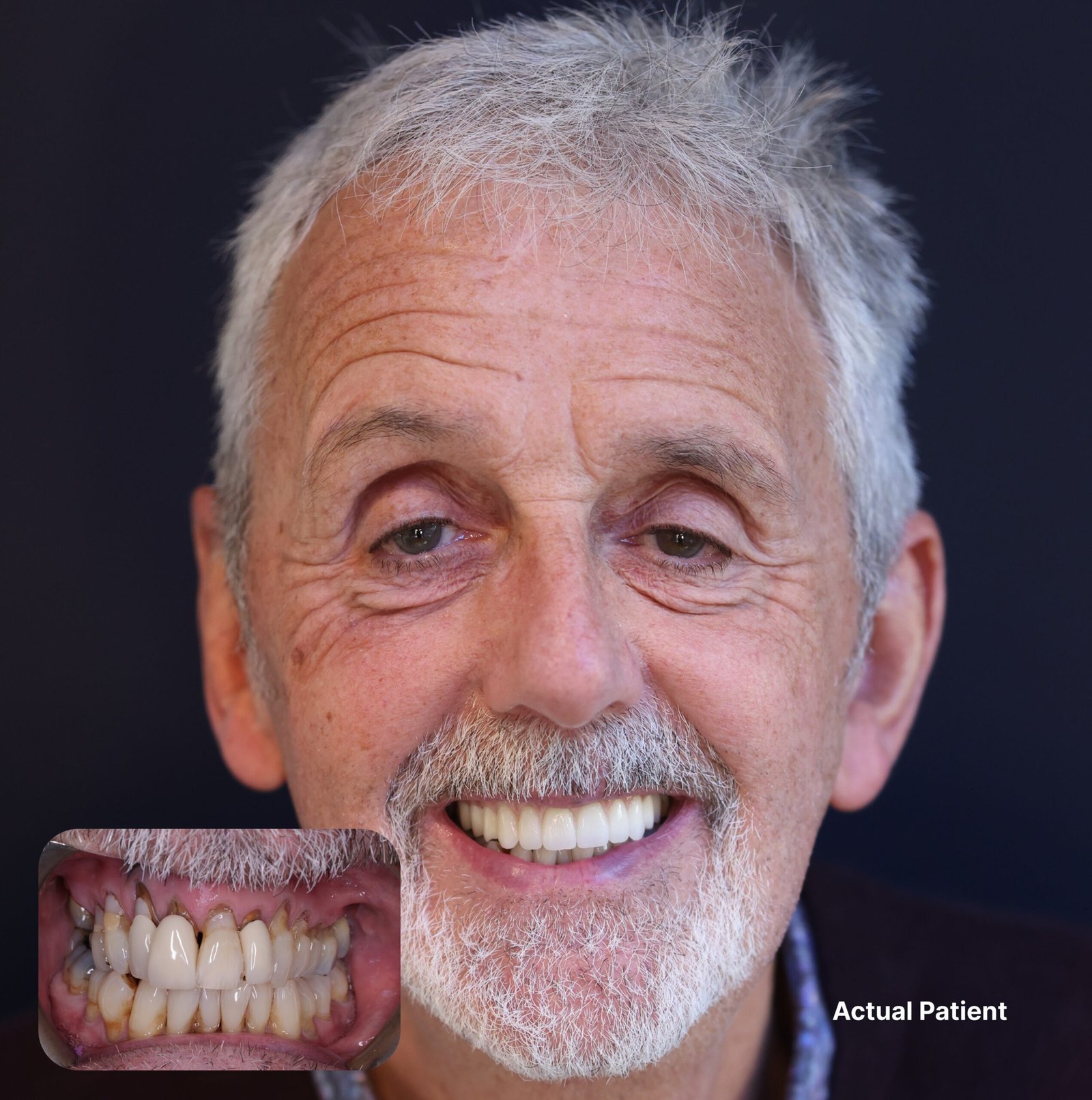
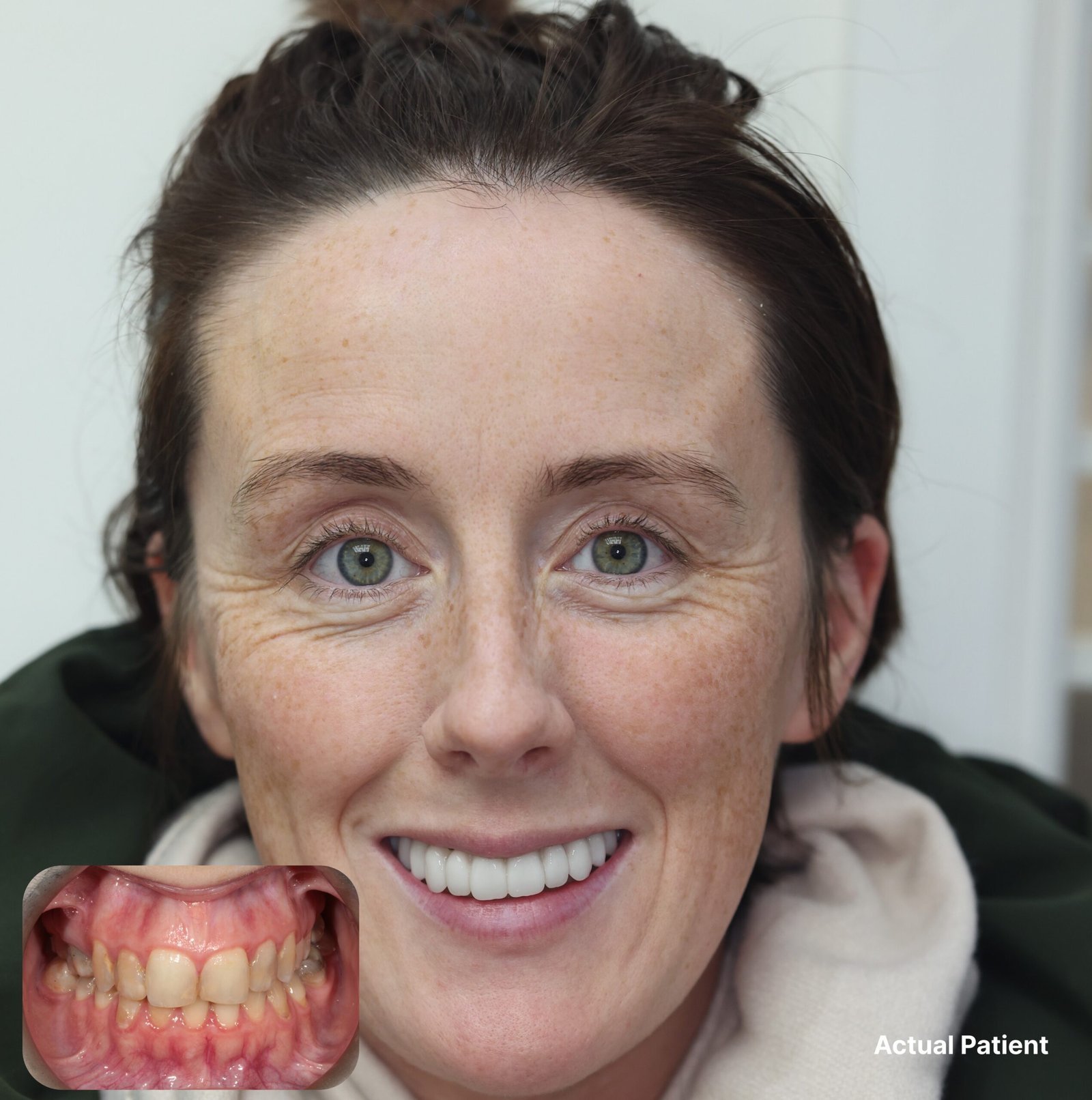
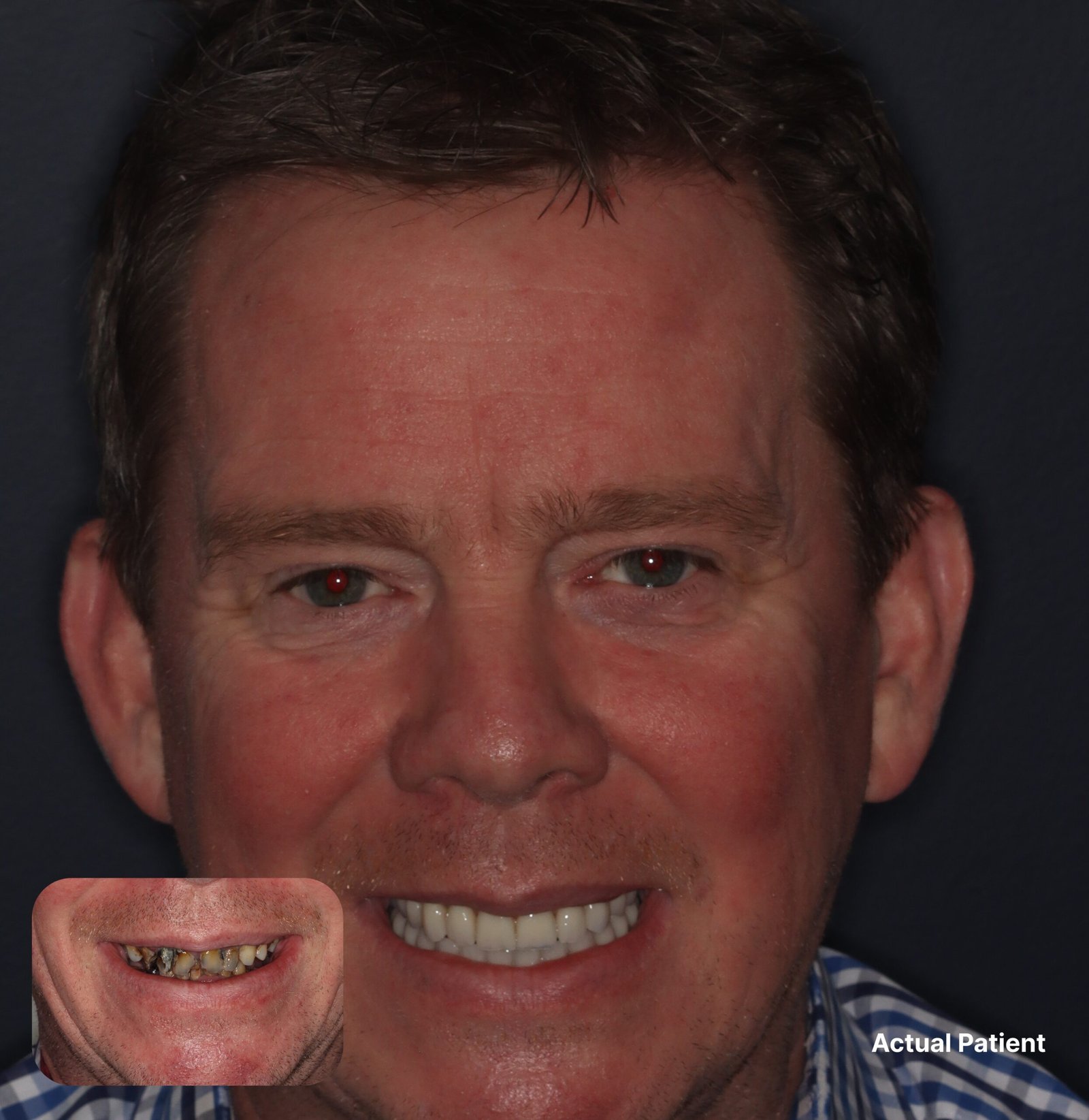
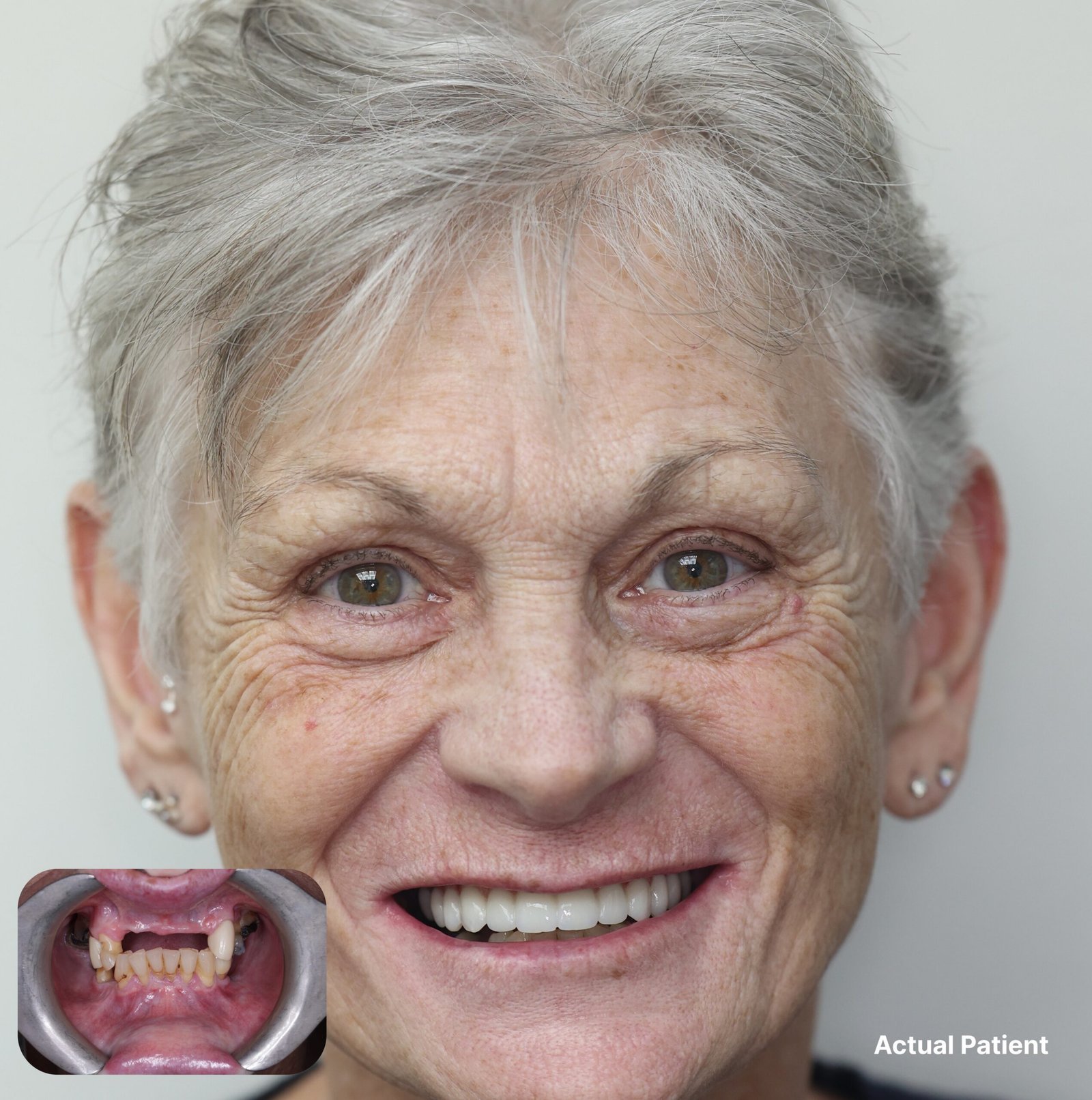
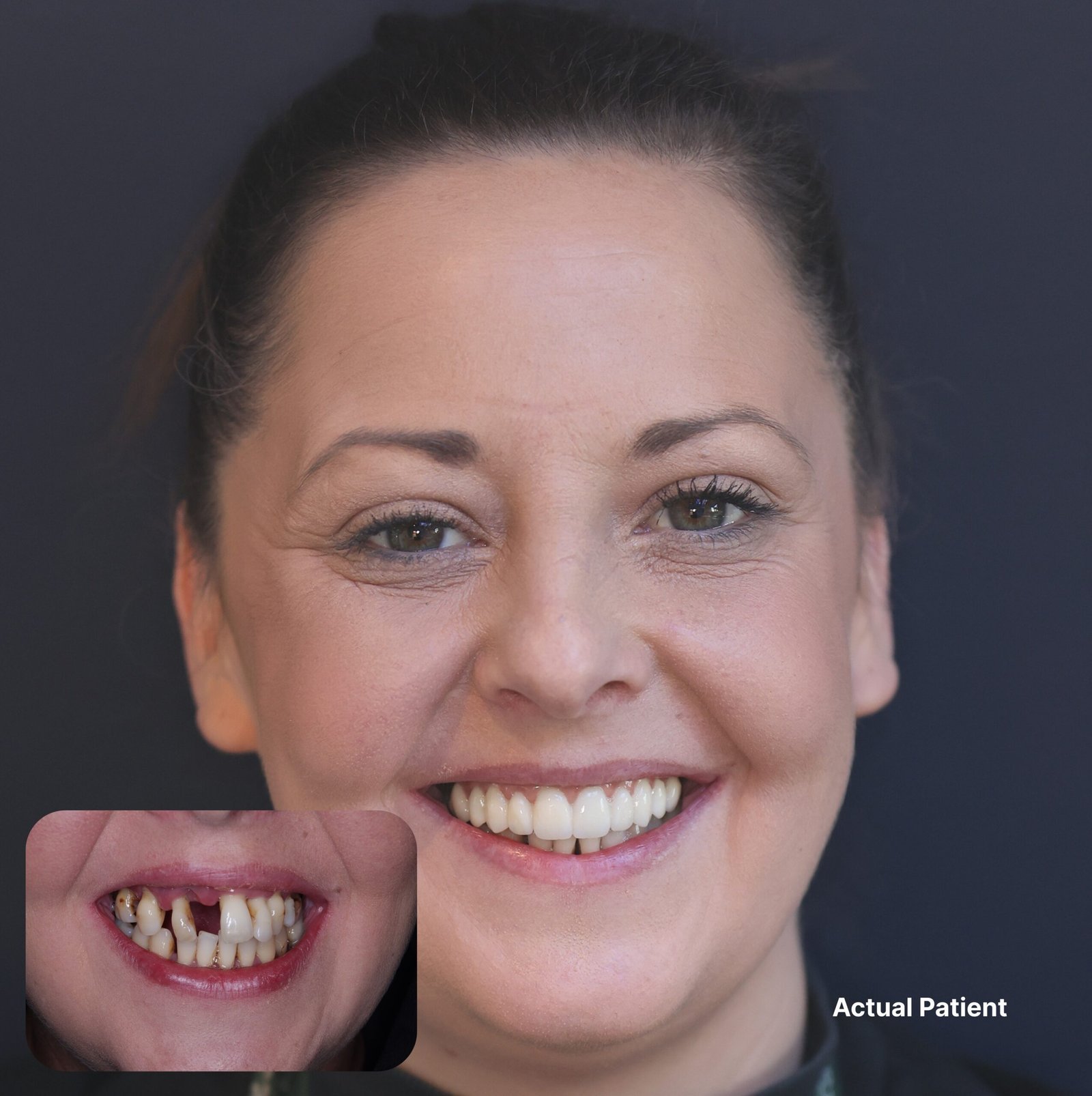
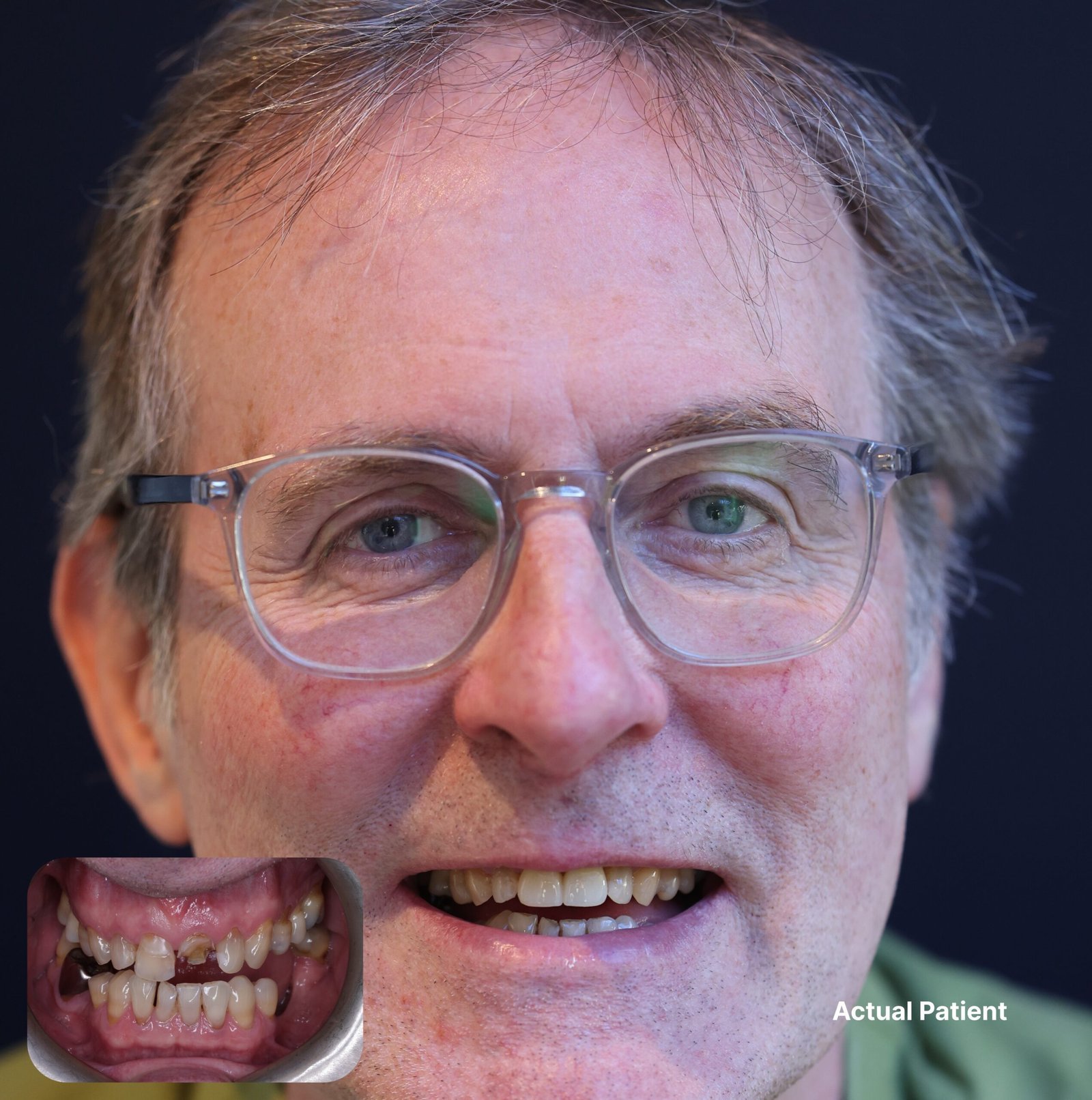
Be our Next Success Story!
Experience personalised dental care designed to help you achieve your dream smile.
Here's what I actually do in plain English
I know “dental implant” can sound daunting before you understand what it involves. So let me explain it simply.
When a tooth is lost, two things are missing: the visible tooth above the gumline, and the root underneath it. Most replacement options only deal with the first part. An implant deals with both.
I place a small titanium post into the jawbone where your missing tooth was. That post acts as a new root. Over the following weeks it fuses with the surrounding bone, a completely natural process that creates a stable, permanent foundation. Once that’s done, I fit a custom-made porcelain crown on top. It’s designed to match the exact colour, shape, and size of the teeth around it.
The result is a permanent tooth. You brush it like a normal tooth. You eat with it like a normal tooth. You forget it’s there, which, honestly, is exactly the point.
Not sure where to begin? Speak to someone.
Make an Enquiry
Related Dental Implant Treatments in Cheshire
- Your Dental implant Journey
Here is exactly what the implant denture process involves
From your first consultation to the moment your implant-retained denture clicks into place for the first time, here is every stage in order.
Free 3D Smile Assessment
Your consultation is completely free and includes a full cone beam CT scan of your jaw. That scan tells me exactly how much bone is available for implant placement, where the implants should sit, and how many are needed to provide the stability you are looking for. You leave with a written treatment plan and a complete cost breakdown covering both the implant-retained option and, if appropriate, the fully fixed alternative. No pressure to proceed.
Free · Approximately 45 minutesFull Case Planning
Once I have reviewed your CT scan, I plan the precise position of each implant and confirm the number needed for your case. I also discuss what type of attachment fitting will be used, how the new denture will be designed, and what the complete treatment timeline looks like. Sedation is available throughout the implant procedure if that would help.
Clinical planning · Fully explained before anything is agreedImplant Placement
The titanium implants are placed into the jawbone under local anaesthetic. For a standard two-implant lower implant-retained denture, placement typically takes 45 to 90 minutes. For cases requiring three or four implants, the procedure takes a little longer. A healing cap is placed on each implant before you leave.
Day procedure · 45 to 90 minutes · Sedation availableHealing and Integration
Over the following 6 to 12 weeks, the implants fuse with the surrounding bone. Your existing conventional denture can continue to be worn in the interim, adjusted where needed for comfort over the healing sites. I check in with you at regular intervals throughout this period.
6 to 12 weeks · Monitored throughoutAttachment Fittings
Once the implants have fully integrated, the attachment fittings are placed on top of each implant. These are the anchor points that the underside of the new denture will clip onto. A short, straightforward appointment.
Short appointment · Minimal discomfortNew Denture Connected and Adjusted
Your new denture, designed with the corresponding attachments on its underside, is fitted. I demonstrate exactly how to insert and remove it, how to clean both the denture and the implants, and what to expect in the days of adjustment that follow. The click into place is something patients consistently describe as surprisingly satisfying.
Final fitting appointment · Approximately 60 minutes- Life after implant dentures
Here is what patients tell me after treatment
Every patient who upgrades from a conventional denture to an implant-retained one describes the change in the same way. They cannot believe they waited as long as they did.
The denture stays exactly where it should
The first thing patients notice is the absence of movement. The denture is clipped onto the implants and it stays there. When they eat, when they speak, when they laugh. The constant monitoring and anxiety about slippage stops, completely.
They eat what they want again
With a stable, implant-retained denture, the list of foods that are off limits shrinks significantly. Patients get back foods they had quietly accepted they would never enjoy again. That return to normal eating has a quality of life impact that patients consistently describe as one of the most meaningful changes.
Their confidence in social situations returns
The background anxiety about the denture, in conversations, at meals, in public, goes away. Patients describe being able to be present in situations that had previously required a layer of management. It is a significant and underappreciated change.
The jawbone stays healthier for longer
Implants stimulate the bone the way natural roots do, slowing the resorption that makes conventional dentures progressively looser over time. The fit of an implant-retained denture remains stable in a way a conventional denture cannot, because the bone beneath it is being maintained rather than continuing to shrink.
No adhesive, ever
This one matters more to patients than it perhaps sounds. The mess, the taste, the unreliability, the daily routine of applying and removing adhesive. All of it stops. The denture clips in. It stays in. It clips out. That is the sum total of the mechanical process.
- Transparent Pricing
How much do implant-retained dentures cost in Cheshire?
Here is a direct answer.
Implant-retained dentures at my practices in Northwich and Wilmslow start from £5,000. This starting price typically covers a two-implant lower implant-retained denture with a new denture. Cases requiring more implants or upper arch treatment will have a higher cost, confirmed precisely at the free 3D Smile Assessment.
Your written cost plan will also include the cost of fully fixed implant options alongside the implant-retained denture cost, so you can compare the two approaches and make an informed decision.
IMPLANT-RETAINED DENTURE From £5,000
Starting price Exact cost confirmed at your free 3D Smile Assessment
What is included:
- Free 3D CT scan and full consultation
- Titanium implant placement, Osstem TSIII system
- Attachment fittings on each implant
- New custom denture with corresponding attachment connections
- All follow-up appointments during the treatment period
- Full written treatment plan and aftercare guidance
Finance Block:
0% finance via Tabeo
Tabeo offers 12 months’ interest-free finance on implant-retained denture treatment. For repayment periods beyond 12 months, an APR applies. Full details and representative examples are discussed at your consultation before you commit to anything.
- Talk to Our Team
Not sure if you're suitable? Give us a call. There's no obligation.
We understand that choosing a dental implant is a significant decision. Our team is here to answer any questions, with no pressure, no sales tactics, and no obligation to proceed.
- START WITH A CONSULTATION
What Your Free 3D Smile Assessment Includes
Full 3D CT Scan
A full cone beam CT scan of your jaw — included at no charge. This gives Dr Nikhil a precise picture of your bone density, nerve positions, and implant suitability.
Written Treatment Plan
You will leave with a full written treatment plan and a complete cost breakdown. Nothing is left vague or estimated.
An Honest Conversation
Dr Nikhil will take the time to understand your situation, answer every question, and give you an honest clinical opinion — with no pressure to proceed.
Finance Options Explained
If 0% finance is right for you, we will walk you through the options in detail so you can make a fully informed decision.
Response Within 1 Working Day
We respond to every enquiry within one working day. Often same day.
- Making the right choice
What is the difference between implant-retained dentures, conventional dentures, and fully fixed implants?
It is the question patients ask most often before booking. Here is the honest comparison.
| Implant-Retained Denture | Conventional Denture | Fully Fixed Implants | |
|---|---|---|---|
| Stability | Secure, clicks onto implants | Rests on gum, can move | Fixed permanently, never moves |
| Removable | Yes, for cleaning | Yes, daily removal | No, stays in permanently |
| Adhesive needed | No | Often yes | No |
| Preserves jawbone | Yes, implants stimulate bone | No, bone continues to recede | Yes, fully |
| Eating without restrictions | Significant improvement | Limited | Full restoration |
| Cleaning | Remove and clean separately | Remove and clean separately | Brush like natural teeth |
| Starting cost | From £5,000 | Lower upfront | From £11,500 per arch |
| Long-term bone health | Good | Poor, bone recedes over time | Excellent |
- MEET YOUR CLINICIAN
Meet Your Implant Dentist, Dr Nikhil Oberai MSc
The difference a stable implant-retained denture makes to a patient who has been struggling with a conventional one for years is one of the clearest quality of life improvements I see in my practice. The change is immediate, tangible, and deeply appreciated by patients who had stopped expecting things to feel different.
I hold a Master’s Degree in Dental Implantology from the University of Manchester and have been placing implants for over a decade. Every patient who comes to me about denture instability gets an honest assessment of all the options available to them, including both implant-retained and fully fixed alternatives, and a clear picture of the costs and clinical considerations involved in each. I will always tell you which approach I think is best for your specific situation.
“For every problem, there is a solution. It might be challenging, but it is almost always possible.”
Credentials:
- BDS, University of Manchester (2008)
- MSc Dental Implantology, University of Manchester (2014)
- Honorary Clinical Teaching Fellow — University of Manchester
- Key Opinion Leader — Osstem UK
- External Examiner, BAIRD Implant Course
- Award Winning dentistry
- GDC No. 150126
- Frequently Asked Questions
Frequently Asked Questions About Implant Retained Dentures
Here are the questions our implant dentures patients ask most often — answered honestly and in plain language.
A conventional denture rests on the gum surface and relies on suction and adhesive to stay in place. An implant-retained denture clips securely onto two, three, or four titanium implants placed in the jawbone. The result is a denture that stays firmly in place when you eat, speak, and laugh, with no adhesive required and significantly more stability in everyday use.
The most common configuration for a lower implant-retained denture uses two implants. An upper implant-retained denture typically requires four, because the upper jaw has less natural bone density and suction than the lower. In some cases three implants per arch are the right approach. The exact number for your case is confirmed by the CT scan at your free assessment.
At my practices in Northwich and Wilmslow, implant-retained dentures start from £5,000. This typically covers a two-implant lower implant-retained denture with a new custom denture. Your exact written cost is confirmed at the free 3D Smile Assessment. 0% finance through Tabeo is available from the assessment appointment.
In some cases an existing denture can be modified to accept the new attachment fittings, which reduces the overall cost. In other cases a new denture is needed, either because the existing one is too worn or because its design is not suitable for conversion. This is discussed and confirmed at your consultation.
The implant placement is carried out under local anaesthetic and sedation is available throughout. Most patients find the procedure more straightforward than they anticipated. There is typically some tenderness and swelling in the days following placement, managed with standard pain relief and detailed aftercare guidance from my team.
From the implant placement to the fitting of the final implant-retained denture, the process typically takes four to six months. This includes the healing period while the implants integrate with the bone. Your existing denture is worn throughout this period, adjusted where needed for comfort.
An implant-retained denture is removable for cleaning. Fully fixed implant teeth are permanently attached and never leave the mouth. Both use implants for stability. The difference is in the final restoration and whether it is fixed or removable. Implant-retained dentures are generally more cost-effective and involve less surgical preparation. Fully fixed implants offer a more permanent, natural-feeling result. I discuss both options at every implant denture consultation so patients can make an informed choice.
This is worth exploring properly before accepting as a conclusion. For many patients with reduced bone density, two to four implants for a retained denture require less bone than a full fixed arch reconstruction. The free 3D CT scan gives a precise picture of what is available and what is possible.
Call Croft Dental in Wilmslow on 01625 523 524, or Brunner Court in Northwich on 01606 440 394, or complete the enquiry form above. My team will be in touch within one working day, usually the same day.